Showing posts with label The Three C's. Show all posts

Wednesday, April 03, 2013

The 6 C's of Education For The Future

During the first class meeting of my cohort for  a Masters in Educational Administration, I was introduced to a very unique idea for the focus of secondary education.  At least for me this may have been a unique idea.  The concept put forth to the class was simply that the focus of education at the secondary level needs to be centered upon three basic ideas: teaching students to think critically, work collaboratively and communicate effectively.  The premise is that through all subjects these “Three C’s” must be at the core of the education as it is these three concepts that will prepare students for their future.

The idea was, that in order for our current students to succeed in their future they needed to be adept in these three basic skill sets.  In a world where the only thing certain is that things change and where the future of the job market can no longer be mapped for fifty years as was once the case before the technological revolution.  It is almost impossible now to predict what the job market will look like five years from now let alone ten or twenty years down the line. It is imperative that students become problem solvers through the use of critical thinking skills.  In turn students must be capable of communicating effectively in that process and through the results of these problem solving efforts.  And, because there are very few jobs where there is only one employee, the ability to collaborate is an absolute must in the world today and in the future.

For me this was educational enlightenment even with twenty years of teaching on my resume.  This actually made sense to me.  I immediately started to plan and refocus my classroom to incorporate these three core ideas.  I read everything I could on critical thinking and how to incorporate more in depth problem solving into my science classes.  I looked for methods to improve the means of communication in the classroom focusing on the importance of all types of communication verbal, visual, written as well as through technology.  I have always encouraged student collaboration in my classroom, and this served to further my resolve to get students to become more active in their roles in the classroom. I was adamant that students work together in a variety of ways throughout each class period.

The last four years I have emphasized these three skill sets in each of my courses.  I have created more project based learning into all of my courses.  Requiring students to analyze research and present their findings.  I increased the amount and level of writing in the science curriculum through TEDitorials using TED videos to encourage students to defend or deny points made by the TED speakers.  I posted the Three C’s in my classroom and held periodic reviews to make sure students and I clearly understood how these ideas were being incorporated throughout the curriculum.  I encouraged student input in how to develop the “Three C’s” further in my classroom.
I was truly energized by this new focus.

Then I presented a professional development workshop on “Dynamic Teaching in the Block Schedule” at a charter high school in Los Angeles.  As part of that presentation I included the concept of the “Three C’s”.  The response was quite positive from all of the teachers in attendance.  The discussion was energetic and the ideas for their classrooms were flowing. And then the first suggestion came to amend the “Three C’s”.
“What about adding Make Connections?” the first suggestion came.

“How about Creativity and Culture?”
Obviously, there are going to be individuals who will feel the need more than three.  But, I was happy with my three and graciously agreed that each teacher could adapt the idea as they would need to for their classroom.

Then I saw two TED Talks by Sir Kenneth Robinson, “Bring on the Learning Revolution” and “Schools Kill Creativity.”  I followed that up with his book “The Element: How Finding Your Passion Changes Everything.”  Then my daughter gave me the book “Imagine: How Creativity Works” by Jonah Lehrer.  That was quickly followed up by “A Whole New Mind: Why Right-Brainers Will Rule the Future”, by Daniel H. Pink.   And of course I viewed his TED, “The Puzzle of Motivation.” In between all of this I also saw Dan Meyer’s TED “Math Class Needs a Makeover,” and started to follow his work online about real life problem solving in math without using the text.
Each of these resources increased my focus on the “Three C’s” but also forced me to reconsider the idea of amending the list as had been suggested at the workshop.  In each of these TEDs and books the picture of the future is one of a constant state of flux.  A never ending series of changes that will leave the students of today useless if they cannot adapt.  The second point that is apparent in all of these sources is the idea that the job market in the United States will only continue to shrink as most jobs that require rote memory and programmed responses are being outsourced to the cheaper job markets of China and India where their unemployed workforce outnumbers the entire population of the united States.  Therefore, students of today must be on the cutting edge of creativity and design.  A skill set that must tap into imagination and creativity.  Which leads to the third idea to come out of my reading concerning the current push in education toward a STEM based curriculum.  While STEM is a good start to a transformation of our current model of education, it stops short of what our students will need for their futures.  The STEM model must be transformed to a STEAM model.  Science, Technology Engineering and Math are worthless in today’s world without the functionality and purpose of design that is a direct correlation to the Arts.

The last concept that these materials provided was the idea of purpose.  That today and in the future everything that we do, must be attached to some common good.  From Whole Foods to Avon, from NBA Cares to Clayton Kershaw and his wife, success in business must have a sense of purpose.  That, what we do and what we create and even the things we say must be in light of giving back in some way to those less fortunate than ourselves or to those who make our success possible.  This new generation of students are initiated into a framework that demands that they have the desire to give back in order to give their work and their success a sense purpose.
It is therefore that I will transform my original “Three C’s” and amend them to become The 6 C’s for the future of Education.  The new list includes: Think Critically, Communicate Cleary, Work Collaboratively, Embrace Culture, Develop Creativity and Utilize Connectivity.  

  1. Critical Thinking allows the individual to manage information. Information presented in a multitude of forms from a variety of media. Information that must be filtered and analyzed, authenticated and processed, and eventually must be synthesized in a form that will be useful to the individual. 
  2. Communication provides the means by which the individual can present information. Information presented in a multitude of means through a variety of media. Information that must be clear and concise, effective and engaging, and eventually be presented in a way that is meaningful to the individual and the audience.
  3. Collaboration engages the individual in the world they share through association. Association, that is created to benefit an organization and as a means to conduct business. Association that includes partnership and teamwork, leadership and assistance, and alliance that serves to benefit the whole.
  4. Culture encourages the individual to appreciate where we have come from, who we are now and how we can move into the future.  Culture associates the individual to all that surrounds them: art, drama, dance poetry, history, science, religion, written and unwritten language, technology and the individual themselves.
  5. Creativity provides the avenue for expression.  The structure means nothing without function.  Therefore, the individual must be capable of creating something with the knowledge that they have worked so hard to obtain.  It is in creating that the individual gains purpose.
  6. Connectivity places the individual in touch with their world.  In today’s existence that is increasingly through the technology that is rapidly changing the way they view their world.  Understanding that connections are personal no matter what the means of contact and that humanity must remain in light of how the technology may change for each individual.
Can this be done in a world that measures student success by their GPA, their Alphabet Test (STAR, CAHSEE, SAT ACT, LSAT, MCAT, GRE etc…) Scores, and the shopping list of college acceptance letters? Can education be transformed in such a way that these non-standardized concepts can be placed at the core of the educational process? 

As an educator, I will continue to make these the priority in my classroom and in my discussion on transforming education.  My students will leave my room each and every day, each and every week month and year, with the understanding that their future may just lie in the mastery of the “6 C’s of Education for the Future”.

Monday, August 27, 2012

Teaching the Three C's Video

"The illiterate of the 21st Century will not be those who cannot read or write, but those who cannot learn, unlearn and relearn."
                  - Alvin Toffler -


XtraNormal video about the need to focus on the Three C's, Critical Thinking, Clear Communication and Collaboration. 

Tuesday, March 20, 2012

TEDitorials

During the last two years, I have tried to increase the Effective Communication aspect of the
Three C's of the science curriculum in my classroom.
Students have become so compartmentalized in the subjects we teach they tend not to bring their English minds to the table when it comes to writing in science.  While I explain to students that their are differences in the way we may present information in science, it is important that their written communication is organized, clear and concise and demonstrate the same expectations of gramar, punctuation, capitalization and spelling as they would in a paper for English or History.


To accomplish this, I have used an assignment called a TEDitorial.  I select and post a TED video (http://www.ted.com/) on my classroom Moodle site every Monday throughout the semester.  Students must view five TEDs throughout the semester and compose and post an editorial supporting or denying the claims of the TED presenter.  Students must incorporate their own research and information from our classroom discussions to support their opinion of the presenter's information. 

The trend through three semester of this assignment has been very typical.  I usually need to spend a great deal of time explaining the difference between a summary of the TED and an editorial for the first two submissions.  I also spend a great deal of time correcting the English aspects of their writing. Which most students can't seem to understand why this is important in science course.  By the third submission most students are actually writing editorials and submitting extra in the way of links to websites they discovered while researching the topic further.  I also have discovered that interest tends to peak about the fourth editorial and students watch several of the TEDs before choosing one that they have more passion about and truly want to editorialize.

I have found that many students begin to visit the TED site on their own to search out information about other topics on top of the science and learning based TEDs that I have selected for them.

Thursday, December 15, 2011

Dynamic Teaching in the Block


The Dynamic Teaching in the Block Schedule Workshop focuses on the creation of a community of learning, based upon those skills that are absolutely necessary for students to transition into their future.  A future where the majority of jobs do not even exist yet, using technology that has yet to be invented and solving problems that have not yet been created.  The skills students must master for success in the next three decades are the Three C's of learning: Think Critically, Work Collaboratively and Communicate Effectively.  It is these three skills that educators should promote within their classroom whether the curriculum path they are on is English, History, Math, Science, Art or Technology.


The workshop will incorporate powerful teaching strategies to enhance the culture of learning, to enhance problem solving skills, increase student participation, develop creativity and increase collaborative abilities. Teachers will be immersed in a classroom experience that places the student at the center of the learning and allows the teacher to become the mentor of their learning success. Imbedded in the workshop is the idea that transforming teachers in to the "Guide on the Side" will have a more positive influence on student learning than does remaining the "Sage on the Stage".  


Dynamic Teaching in the Block Schedule will provide a model of an interactive and robust classroom where both students and teachers value learning as a process of exploration and discovery.

For more informaiton on this workshop contact Brian S. Miller at smarterteacher@gmail.com.

Monday, November 14, 2011

Collaborative Learning Teams

COMMUNICATE- COLLABORATE - THINK CRITICALLY

"The strength of the team is each individual member.
The strength of each member is the team."
                                                                 - Phil Jackson

The development of a network of collaborative learning teams within you classroom can create an educational environment where the responsibility for learning lies upon both the students and teacher who comprise that leaning community.

Learners learn by teaching one another. When students teach one another they take ownership of the material by passing it along they actually make it part of themselves. 

The process of teaching one another is by its very nature acive learning.  Student engagement increases the opportunities to learn. 

The saying goes that "Two heads are better than one."  Sharing knowledge creates opportunities for more ideas, alternate approaches, increased possibilites and new perspectives.

Students who have difficulty in the larger classroom may find comfort in smaller groups. This provides avenues for increased communication and the unleashing of ideas that may never be shared in a larger group setting. 

Collaboration brings about an ease and comfort that encourages further attendance in the class as interdependence breeds both responsibility and commraderie. 

Although the goal is increased learning for all, the idea of positive competition among smaller groups may lead to greater problem solving success.

Collaboration encourages the development of leadership skills.

Students who work in groups learn to delegate tasks to maximize group success.

Collaboration increases the development of time mangement skills.    


"Coming together is a beginning, staying together is progress, and working together is success."
                                                             - Henry Ford

Wednesday, November 09, 2011

Chaos Towers Revisited

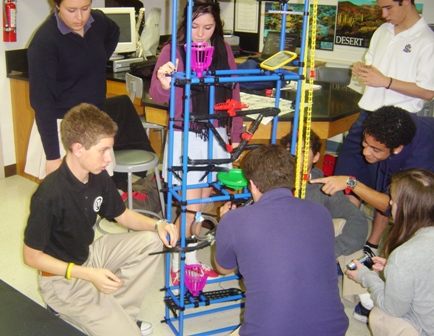
The Conceptual Physics class worked on chaos towers to demonstrate concepts of Physics, Mechanics, Falling Objects, Newton's Law, Potential and Kinetic Energy.

CHAOS WORLD OF MOTION

Teaching Physics Toy - Construction Toy Equipment - Child Construction Toy - Educational Learning Toy


Students work in three groups to construct the chaos towers. They then draw vector diagrams representing velocity of the marble through the track.  Students then identify five concepts from first semester physics and explain how they are represented on the chaos tower.  Lastly, they evaluate each member of their group against the Three C's: collaboration, communication and critical thinking. 


This year one of my students put together a quick video of the chaos towers in action. 


Monday, September 26, 2011

Professional Development Workshop

DYNAMIC TEACHING IN THE
BLOCK SCHEDULE


The Dynamic Teaching in the Block Schedule Workshop focuses on the creation of a community of learning, based upon those skills that are absolutely necessary for students to transition into their future.  A future where the majority of jobs do not even exist yet, using technology that has yet to be invented and solving problems that have not yet been created.  The skills students must master for success in the next three decades are the Three C's of learning: Think Critically, Work Collaboratively and Communicate Effectively.  It is these three skills that educators should promote within their classroom whether the curriculum path they are on is English, History, Math, Science, Art or Technology.


The workshop will incorporate powerful teaching strategies to enhance the culture of learning, to enhance problem solving skills, increase student participation, develop creativity and increase collaborative abilities. Teachers will be immersed in a classroom experience that places the student at the center of the learning and allows the teacher to become the mentor of their learning success. Imbedded in the workshop is the idea that transforming teachers in to the "Guide on the Side" will have a more positive influence on student learning than does remaining the "Sage on the Stage".  


Dynamic Teaching in the Block Schedule will provide a model of an interactive and robust classroom where both students and teachers value learning as a process of exploration and discovery.

For more information on scheduling this workshop for your school faculty, contact Brian S. Miller at smarterteacher@gmail.com.

Thursday, September 22, 2011

A-Z BLOG FOR THE 21ST CENTURY EDUCATOR

“The illiterate of the 21st century will not be those
who cannot read and write, but those who cannot
learn, unlearn and relearn." 
                                  - Alvin Toffler -

From A-Z, Helping Teachers Work Smarter not Harder in the 21st Century Classroom, is a wonderful blog  created by Ann Zimmer, co-Director of the Center for 21st Century Classrooms.

The blog provides a wealth of materials, media and links, that are invaluable for educators who are challenged by the educational systems and general state of learning in the new century.  This website provides great suggestions and discussion points that will help educators to understand the basis for changing the paradigms in our classrooms as we prepare students for a world that is no longer predicatable and shrinks with each new technological shift. 

I truly believe that Ms. Zimmer has spent time in my classroom as  the video piece she created called "The Challenge", quotes Alvin Toffler and the 21st Century definition of illiterate, brings in pieces from "Shift Happens" on the job market and   ties in many aspects of the Three C's, communication, critical thinking and collaboration. 

The Challenge
from the A-Z Blog


Wednesday, August 31, 2011

Do Your Students Memorize the Periodic Table?


Every truth has four corners: as a teacher I give you one corner, and it is for you to find the other three.


- Confucius -


Frequently, when I mention the fact that I teach chemistry, the first question in response is, "Do you still have them memorize the periodic table?"  This of course is followed by an explanation of how they remember having to memorize all of the elements, the names, the symbols and of course the masses, and how they can no longer remember any of it.

My first inclination is to break into a tirade about my theory of teaching, the Three C's and building a culture of learning.  And, how I do not believe memorization is learning.  How if you memorize something, this does not mean you know what it is or how to utilize it. I would continue that I do not sit down and memorize the recipies in order to cook a meal.  But if I cook the meal well enough a number of times the recipie becomes a part of my knowledge base.  And, that the more times I cook the meal, the less often I need to refer to the recipie.

That is why I give all of my students a periodic table that I have created. I gathered ideas from the other chemistry teachers I work with as well as using information found on the various periodic tables available online and through science distributors like Fisher and Flinn and of courseI looked at a variety of periodic tables in textbooks.  From all of this I designed a periodic table that is a tool that can be used by the students to successfully navigate their year of chemistry.


I allow my students to use their periodic table during all of their work throughout the year, including in class work, quizzes, tests, homework, online assignments, the entire workload for the year.  Invaribly if the students use a this tool enough, the information on the periodic table will become part of their knowledge base and eventually they will use the most repetitive information without referring to the table as the year progresses. Of course, the elements that are used most often like oxygen, carbon, hydrogen, nitrogen sodium and chlorine, are the elements that become part of the students knowledge base.  How often, really, do we use Praseodynium [59 Pr - 140.91amu] or Erbium [ 68 Er - 167.26amu] or in the course of our lives?

Therefore, my answer is a resounding NO!!!! I do not have my students memorize the periodic table.  I do however, expect them to master the use of the periodic table as a problem solving tool throughout their year in chemistry and beyond.


Tuesday, May 03, 2011

CHAOS is an Opportunity to LEARN

"Chaos in the world brings uneasiness, but it also allows the opportunity for creativity and growth."
 - Tom Barrett -

Do you remember Lincoln Logs, Tinker Toys, Erector Sets, Blocks and the Original Legos?
How much did we learn about the basic components of logic, building and physics from the trial and error of playing with these toys both correctly and in some cases incorrectly.  I know I learned about catapults by launching the single notch lincoln logs using the green roof plank as a lever.  I learned about control over the center of gravity by building towers of blocks and unbalanced lego creations. I learned gear and wheel ratios from tinker toys and erector sets.  While I didn't realize I was learning physics, I came to understand physical phenomena through tinkering and experimentation.

In my Physics class I use Chaos Towers ( http://www.chaostoy.com/ ) to allow students to experience the hands on nature of discovering the physics of Newton's Laws, Poential (gravitational) and Kinetic Energy and the basic ideas behind vetors as a means of mapping motion, displacement, velocity and acceleration. 


  I have three chaos towers in my classroom.  I divide students into three teams and give them two class periods to build the towers.  The towers can be built horizontally and vertically.  I make sure at least one of the towers is built horizontally.  The students prefer the vertical version.

The lessons students learn, even before the concepts of physics are the importance of reading and following directions and the job of delegating the work.  I have students grade each other on their contribution to the building of the tower and collaboration and communication within the group. 
 
Once the towers are built, students analyze directional changes and displacement values of the path of the marbles.  Students determine the gravitational potential energy at various points along the path and compare velocities based upon the PE = KE formula and measured velocities. The trampoline offers students the understanding of action and reaction forces as well as the parabolic arc of a projectile. 

On the Chaos Toy website there a several lessons utilizing smaller component portions of the towers. http://www.chaostoy.com/cd/html/defau_e.htm

The hands on nature of the tower and the collaborative aspects of the group work, provide a tremendous learning environment for my students.


"I have great belief in the fact that whenever there is chaos, it creates wonderful thinking. I consider chaos a gift."
   

Tuesday, March 01, 2011

Designing Games for the Three C's

One on the best projects I have found to incorporate all of the Three C's (Thinking Critically, Communicate Clearly and Work Collaboratively) is to have students work in groups to design a game to teach one of the topics we are learning.

I use this assignment primarily in my Anatomy and Environmental Science course, but it could be adapted for any subject.  In Anatomy I have students work in groups of three or four to create a game to teach the anatomy and physiology of the Digestive System from the mouth to the Anus and all of the organs and processes in between.  The Environmental Science students design games to teach a Cycle of Nature: water, carbon, nitrogen, food webs from various biomes.  I teach in a three block schedule of ninety five minunte classes.  I provide students with 30 minutes each day to work with their groups on their games.  Students typically have about three weeks to complete the games, about six class periods.   


Think Critically
Students are asked to design a game with specific rules and an ultimate goal of winning, while focusing on the development of a game that is a teaching and learning tool. Students need to understand the vocabulary, structures, inputs, processes and outcomes of the systems involved. The game must be fun to create a desire to play in order to create the repetition necessary for others to learn from the game play. Students must think critically about how to create a game that will be enjoyable so tha people will want to play it repetitively to increasethe effect of the game as a learning tool.  I encourage students to create games that have variations so that the game can be adapted for various levels of students as a means of introducing the subject, reinforcing learned material or in review for an exam.

Communicate Clearly
Students struggle with the creation of a clear and concise set of rules for their games. They need to communicate their vision for the game in directions and rules that must be prepared for an unknown audience. Most students have little difficulty in verbally explaining how to play a game, but ask them to write the rules and explanations out in a cohesive manner and this can be a cause for great angst for many students.

Working Collaboratively
Coming to a consensus on the game design, delegating responsibilities and producing a finished product demands nothing but a collaborative buy in from the members of the group. Then each student must trust that all aspects of the game come together on Game Day, board, cards, pieces and rules in class and on time.

Game day takes place in our dining hall.  Groups set up their own games and play them for 10 minutes to make sure  games are functional and everything is in place.  They then move about the room playing the other games and grading them.  Students grade the games based upon the effectiveness of the game itself, the effectiveness of the game as a learning tool, and the production quality of the game.  Once students begin playing other games, they are not allowed to return to their own game for any reason. I encourage students to play the games with members of the other groups to maintain perspective and avoid comparisons to only their own games. 
Students will play and score between four and six games during a one hour period.

During the debriefing at the end of the day, I am always amazed at how many students want to be given the opportunity to improve their own game after seeing what others have done and what they might have done to enhance their own.  That is when I see the real learning take place as students evaluate their own work against the work of the peers and demonstrate an honest desire to improve upon their end product.  I typically also see a more focused production quality of the work that is turned in following these projects in both courses.

Friday, February 04, 2011

Film Favorites - 12 Angry Men

There is a distinct difference between showing a movie to take up class time and utilizing a movie to enhance your curriculum.  It should be clearly understood that movies shown in class have a defined purpose within your curriculum.  There are several movies that I incorporate into my classroom to introduce a topic, create discussion and support the curriculum.

There are a few movies that provide great possibilities in a variety of subject areas.  One of my favorites for this is 12 Angry Men.  I will only show the original with Henry Fonda, in black and white.  After the initial shock of seeing a movie that is not in color students do settle in and can focus on the content of this film. 


The jury of twelve 'angry men,' entrusted with the power to send an uneducated, teenaged Puerto Rican, tenement-dwelling boy to the electric chair for killing his father with a switchblade knife, are literally locked into a small, claustrophobic rectangular jury room on a stifling hot summer day until they come up with a unanimous decision - either guilty or not guilty. The compelling, provocative film examines the twelve men's deep-seated personal prejudices, perceptual biases and weaknesses, indifference, anger, personalities, unreliable judgments, cultural differences, ignorance and fears, that threaten to taint their decision-making abilities, cause them to ignore the real issues in the case, and potentially lead them to a miscarriage of justice.
Fortunately, one brave dissenting juror votes 'not guilty' at the start of the deliberations because of his reasonable doubt. Persistently and persuasively, he forces the other men to slowly reconsider and review the shaky case (and eyewitness testimony) against the endangered defendant. He also chastises the system for giving the unfortunate defendant an inept 'court-appointed' public defense lawyer who "resented being appointed" - a case with "no money, no glory, not even much chance of winning" - and who inadequately cross-examined the witnesses. Heated discussions, the formation of alliances, the frequent re-evaluation and changing of opinions, votes and certainties, and the revelation of personal experiences, insults and outbursts fill the jury room. (http://www.filmsite.org/twelve.html)

Topics and Themes
  • the judicial system and trial by jury
  • analysis of information and data
  • critical thinking
  • collaboration
  • communication
  • standing up for what you believe
  • consensus building
  • prejudices
  • cultural differences
  • fears
  • racism
  • just vs fair
  • stereotypes
  • psychology of man


Wednesday, February 02, 2011

The Three C’s

A quote from Alvin Toffler reads, “The illiterate of the 21st century will not be those who cannot read and write, but those who cannot learn, unlearn and relearn." 

The average individual in the United States will change careers three times and be employed in twelve different jobs before the age of forty.  How can today’s educator equip students with the skills necessary to succeed in a world where change seems to be the only constant?  How is it possible to train students for jobs that have not yet been imagined, to keep up with technology that has not yet been invented?

No longer can educators saddle themselves with the idea that competence in the 3 R’s (Reading, wRiting and aRithmetic) will suffice as the guiding measure of academic and future success for the students entrusted to the educational system of today.  The classroom must therefore engage the students in processes that build upon the tools and skills that will allow them to learn, unlearn and relearn.

Therefore, the focus of secondary education should no longer be the 3 R’s but instead should be predicated on the 3 C’s, Critical Thinking, Clear Communication, and Collaboration.  It is these three skills that will provide a basis for success in a world where careers, technology, and socializing will be consistently changing with a rapidness that is exponential as opposed to the linear change that all generations witnessed prior to the first Apple One being placed in a classroom.


Critical thinking allows the individual to manage information. Information presented in a multitude of forms from a variety of media. Information that must be filtered and analyzed, authenticated and processed, and eventually must be synthesized in a form that will be useful to the individual. 

Communication provides the means by which the individual can present information. Information presented in a multitude of means through a variety of media. Information that must be clear and concise, effective and engaging, and eventually be presented in a way that is meaningful to the individual.

Collaboration engages the individual in the world they share through association. Association, that is created to benefit an organization and as a means to conduct business. Association that includes partnership and teamwork, leadership and assistance, and alliance that serves to benefit the whole.     

The educational process must engage the student in activities that provide for the honing of these three basic skills.  It is an injustice to today’s student for the educational process to be focused upon the solution rather than the process.  It is the obligation of the educator to provide curricular opportunities that engage students in the three C’s. 

Encourage students to travel outside their zones of comfort.  Don’t set the bar, for the bar may inadvertently be too low and discourage the expansion of ideas. Encourage mistakes for mistakes are windows to the possibilities of new processes. Devalue the answer and value the process.  For it is in the process, that these skills are built and where it is in finding the answer, that the process ends.                      

The 1940’s and 1950’s marked an educational era that necessitated the development of job skills. The majority of the population sought only to be job ready out of high school.  Careers were for the college bound. The choices were much simpler as high school graduation led to college to those who demonstrated the academic promise to prepare for a career or who had the family wealth to pursue college without such a focus. The second option was to take up a job in order to learn a trade.  While the third option was the military, where you could learn a trade and then pursue a job upon discharge.

The educational focus of the 60’s and 70’s found high schools preparing students for college in order to forge a career. The learning pedagogy involved skills necessary to succeed in a college setting.  Preparation for choosing a lifelong career path was the therefore the norm and the skills necessary were based upon getting to the next level on that path.

Today, however, it can no longer be assumed that the career of choice today will even be an option tomorrow.  The exponential growth of technology and the relative shrinking of the world through our connectivity and social media invariably makes it impossible to gauge the job skills that will be necessary in the future.

Therefore, the high school student of today must be equipped with the skills that will provide the ability to communicate ideas clearly and effectively, the ability to work independently or within a group dynamic and the ability to think both inside and outside the box. The three C’s must be the standards upon which the education provided to this generation of students is predicated.

Sunday, January 23, 2011

Planting Mangoes

I found this story  many years ago.  I keep a copy over my desk as a reminder that I may never see nor experience the seeds of education I plant in the minds of my students each day, but I believe that what I do for them in my classroom is invaluable to their development into adults who think critically, communicate effectively and work collaboratively to make positive change in this world that we share.     
It was time for the monsoon rains to begin and a very old man was digging holes in his garden
“What are you doing?” his neighbor asked.
“Planting mango trees” was the reply.
“Do you expect to eat mangoes from those trees?”
 
“No, I won’t live long enough for that.  But others will. 
 It occurred to me the other day that all my life I have enjoyed mangoes planted by other people.  This is my way of showing them my gratitude.”