Showing posts with label Critical Thinking. Show all posts

Wednesday, April 03, 2013

The 6 C's of Education For The Future

During the first class meeting of my cohort for  a Masters in Educational Administration, I was introduced to a very unique idea for the focus of secondary education.  At least for me this may have been a unique idea.  The concept put forth to the class was simply that the focus of education at the secondary level needs to be centered upon three basic ideas: teaching students to think critically, work collaboratively and communicate effectively.  The premise is that through all subjects these “Three C’s” must be at the core of the education as it is these three concepts that will prepare students for their future.

The idea was, that in order for our current students to succeed in their future they needed to be adept in these three basic skill sets.  In a world where the only thing certain is that things change and where the future of the job market can no longer be mapped for fifty years as was once the case before the technological revolution.  It is almost impossible now to predict what the job market will look like five years from now let alone ten or twenty years down the line. It is imperative that students become problem solvers through the use of critical thinking skills.  In turn students must be capable of communicating effectively in that process and through the results of these problem solving efforts.  And, because there are very few jobs where there is only one employee, the ability to collaborate is an absolute must in the world today and in the future.

For me this was educational enlightenment even with twenty years of teaching on my resume.  This actually made sense to me.  I immediately started to plan and refocus my classroom to incorporate these three core ideas.  I read everything I could on critical thinking and how to incorporate more in depth problem solving into my science classes.  I looked for methods to improve the means of communication in the classroom focusing on the importance of all types of communication verbal, visual, written as well as through technology.  I have always encouraged student collaboration in my classroom, and this served to further my resolve to get students to become more active in their roles in the classroom. I was adamant that students work together in a variety of ways throughout each class period.

The last four years I have emphasized these three skill sets in each of my courses.  I have created more project based learning into all of my courses.  Requiring students to analyze research and present their findings.  I increased the amount and level of writing in the science curriculum through TEDitorials using TED videos to encourage students to defend or deny points made by the TED speakers.  I posted the Three C’s in my classroom and held periodic reviews to make sure students and I clearly understood how these ideas were being incorporated throughout the curriculum.  I encouraged student input in how to develop the “Three C’s” further in my classroom.
I was truly energized by this new focus.

Then I presented a professional development workshop on “Dynamic Teaching in the Block Schedule” at a charter high school in Los Angeles.  As part of that presentation I included the concept of the “Three C’s”.  The response was quite positive from all of the teachers in attendance.  The discussion was energetic and the ideas for their classrooms were flowing. And then the first suggestion came to amend the “Three C’s”.
“What about adding Make Connections?” the first suggestion came.

“How about Creativity and Culture?”
Obviously, there are going to be individuals who will feel the need more than three.  But, I was happy with my three and graciously agreed that each teacher could adapt the idea as they would need to for their classroom.

Then I saw two TED Talks by Sir Kenneth Robinson, “Bring on the Learning Revolution” and “Schools Kill Creativity.”  I followed that up with his book “The Element: How Finding Your Passion Changes Everything.”  Then my daughter gave me the book “Imagine: How Creativity Works” by Jonah Lehrer.  That was quickly followed up by “A Whole New Mind: Why Right-Brainers Will Rule the Future”, by Daniel H. Pink.   And of course I viewed his TED, “The Puzzle of Motivation.” In between all of this I also saw Dan Meyer’s TED “Math Class Needs a Makeover,” and started to follow his work online about real life problem solving in math without using the text.
Each of these resources increased my focus on the “Three C’s” but also forced me to reconsider the idea of amending the list as had been suggested at the workshop.  In each of these TEDs and books the picture of the future is one of a constant state of flux.  A never ending series of changes that will leave the students of today useless if they cannot adapt.  The second point that is apparent in all of these sources is the idea that the job market in the United States will only continue to shrink as most jobs that require rote memory and programmed responses are being outsourced to the cheaper job markets of China and India where their unemployed workforce outnumbers the entire population of the united States.  Therefore, students of today must be on the cutting edge of creativity and design.  A skill set that must tap into imagination and creativity.  Which leads to the third idea to come out of my reading concerning the current push in education toward a STEM based curriculum.  While STEM is a good start to a transformation of our current model of education, it stops short of what our students will need for their futures.  The STEM model must be transformed to a STEAM model.  Science, Technology Engineering and Math are worthless in today’s world without the functionality and purpose of design that is a direct correlation to the Arts.

The last concept that these materials provided was the idea of purpose.  That today and in the future everything that we do, must be attached to some common good.  From Whole Foods to Avon, from NBA Cares to Clayton Kershaw and his wife, success in business must have a sense of purpose.  That, what we do and what we create and even the things we say must be in light of giving back in some way to those less fortunate than ourselves or to those who make our success possible.  This new generation of students are initiated into a framework that demands that they have the desire to give back in order to give their work and their success a sense purpose.
It is therefore that I will transform my original “Three C’s” and amend them to become The 6 C’s for the future of Education.  The new list includes: Think Critically, Communicate Cleary, Work Collaboratively, Embrace Culture, Develop Creativity and Utilize Connectivity.  

  1. Critical Thinking allows the individual to manage information. Information presented in a multitude of forms from a variety of media. Information that must be filtered and analyzed, authenticated and processed, and eventually must be synthesized in a form that will be useful to the individual. 
  2. Communication provides the means by which the individual can present information. Information presented in a multitude of means through a variety of media. Information that must be clear and concise, effective and engaging, and eventually be presented in a way that is meaningful to the individual and the audience.
  3. Collaboration engages the individual in the world they share through association. Association, that is created to benefit an organization and as a means to conduct business. Association that includes partnership and teamwork, leadership and assistance, and alliance that serves to benefit the whole.
  4. Culture encourages the individual to appreciate where we have come from, who we are now and how we can move into the future.  Culture associates the individual to all that surrounds them: art, drama, dance poetry, history, science, religion, written and unwritten language, technology and the individual themselves.
  5. Creativity provides the avenue for expression.  The structure means nothing without function.  Therefore, the individual must be capable of creating something with the knowledge that they have worked so hard to obtain.  It is in creating that the individual gains purpose.
  6. Connectivity places the individual in touch with their world.  In today’s existence that is increasingly through the technology that is rapidly changing the way they view their world.  Understanding that connections are personal no matter what the means of contact and that humanity must remain in light of how the technology may change for each individual.
Can this be done in a world that measures student success by their GPA, their Alphabet Test (STAR, CAHSEE, SAT ACT, LSAT, MCAT, GRE etc…) Scores, and the shopping list of college acceptance letters? Can education be transformed in such a way that these non-standardized concepts can be placed at the core of the educational process? 

As an educator, I will continue to make these the priority in my classroom and in my discussion on transforming education.  My students will leave my room each and every day, each and every week month and year, with the understanding that their future may just lie in the mastery of the “6 C’s of Education for the Future”.

Tuesday, February 12, 2013

A Fluorescent Engagement in Learning

I believe as long as there have been desktops there has been a constant battle to keep students from writing on the desk. 

But, what if there were a way to allow students to write on the desk in order to engage them in the learning process.

That is where fluorescent markers and black lab tables have found a happy marriage in my classroom.
Using the Expo Fluorescent markers students can write on their desktops to their hearts content, as long as they are working on chemistry. 


Ideas For the Classroom 

  • Pre-written PODs as students come into the classroom.
  • Homework review.  Students share specific problems from their homework. 
  • Students teach each other. To both assist others and to reinforce their own learning. 
  • Students work through problem solving before transferring work into their notes.
  • Brainstorming.
  • Writing out lab procedures. 
  • Recording data, before transferring it to their lab notebook. 
  • Flow charts for work. 
  • Recording discussion notes for sharing with class. 
  • Museum walks of completed work. 
  • Thought questions or quotes to prompt discussion.
  • Whatever your mind can imagine.    


Tuesday, August 28, 2012

What will be on the Final Exam?

Invariably at the end of a semester, despite the organized meandering of the teacher, a group of students will ask, "What will be on the Final Exam?"  Not that they hane not sat through every class and taken copious amount of notes, and completed all of the homework including all of the in class work and the study guides that the teacher has provided. But,without fail, the question will be asked.
What will be on the Final Exam?

 
By the way, I have discovered XtraNormal.com and I am having way too much fun with it.
Not only making my own videos, but looking for ways to incorporate it into my classroom curriculum and have the students creating these video pieces, to share information, create reviews for the "Final Exam" etc...

I will keep you posted when I decide how this will happen in my classroom.

Monday, August 27, 2012

Teaching the Three C's Video

"The illiterate of the 21st Century will not be those who cannot read or write, but those who cannot learn, unlearn and relearn."
                  - Alvin Toffler -


XtraNormal video about the need to focus on the Three C's, Critical Thinking, Clear Communication and Collaboration. 

Wednesday, November 09, 2011

Chaos Towers Revisited

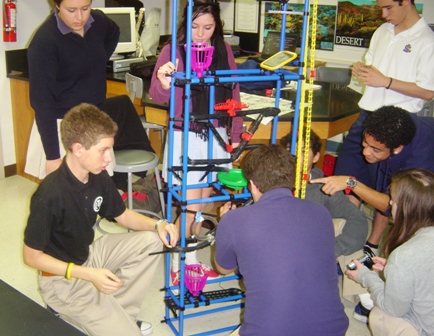
The Conceptual Physics class worked on chaos towers to demonstrate concepts of Physics, Mechanics, Falling Objects, Newton's Law, Potential and Kinetic Energy.

CHAOS WORLD OF MOTION

Teaching Physics Toy - Construction Toy Equipment - Child Construction Toy - Educational Learning Toy


Students work in three groups to construct the chaos towers. They then draw vector diagrams representing velocity of the marble through the track.  Students then identify five concepts from first semester physics and explain how they are represented on the chaos tower.  Lastly, they evaluate each member of their group against the Three C's: collaboration, communication and critical thinking. 


This year one of my students put together a quick video of the chaos towers in action. 


Wednesday, September 28, 2011

The Fence

"The Fence" is a very short video clip that offers a great starting point for discussion topics of man vs. nature. 
In choosing an agriculturist (taker) and eventually an industrialist lifestyle, man has positioned himself first as an enemy of nature and then the defender of nature.
How soon though, will either nature completely disappear or decide to strike back?


Discussion Themes:
Hunter Gatherer to Agriculturalist
Man vs. Nature
Takers vs. Leaver
Man as enemy of Nature
Man's control of the Earth
Endangered Earth
Progress vs. The Environment
etc...etc...etc...


Tuesday, July 05, 2011

Rubrics Can Kill Creativity

Teaching to the Multiple Intelligences is difficult enough.
Today's educational system is so guided by rubrics for every assignment that we are taking away the opportunitiy for students to explore their talents, use their imaginations and utilize their strengths. Students are no longer asked to think, they are simply told to follow the directions, complete what is in the rubric and you will get your 'A'.

One of my favorite projects for Biology is a cells processes project where students are asked to create anything that proves their knowledge of cells, cells structure and function or cell processes.  I provide as little guidance as possible except for the outlawing of a term paper as the product. I want students use their talents and think outside the box.

Of course I deal with the questions of How much? How long? How many? What do I want? What is the answer? What do I need to do for an A? etc...etc...

This type of assignment tends to make students nervous due to the lack of guidelines and parameters, but once they allow themselves to process the possibilities, some amazing things happen. 

I have recieved songs about the organelles of cells, beautiful painting of cell mitosis, games about protein synthesis, I have heard poems about meiosis and puppet shows about osmosis, diffusion and filtration.
Overcoming the fear of meeting expectations and possibly being wrong, allows students to let their talents really shine.

I provide the students with the following basic description of the assignment and allow them to figure it out.

Cell Processes Project

Use your talents to demonstrate your understanding of one of the following topics:


    1.  Cell Structures and Functions

   2.   Comparison of Plant and Animal Cells

   3.    Photosynthesis

   4.    DNA and RNA

   4.    Protein Synthesis

   5.    Mitosis

   6.     Cellular Respiration
           
You may create anything that clearly demonstrates your knowledge of the subject matter.  You may accomplish this by:
creating a work of art,
composing a song,
writing a skit or play,
creating a model,
making visual aid posters,
developing a game,
or anything that you can do to creatively demonstrate your comprehension of the topic material, vocabulary and processes. 

You must have clear instructions, as you will not be presenting these projects.  You may work independently or you may work with a partner.  This partner must be from the same period biology class. 
Be creative.
Do not just copy work from your text or notes.  Repeating the information given or making some applications (e.g. cell models, reports) usually ensures an average grade. 

One of my favorite outcomes of this project  was
The Mitosis Blues, written and performed by a pair of students more than 10 years ago. In their honor, I still use my best Elvis Presley when I sing it to my Biology classes. 

 Mitosis Blues

Interphase, o oh yeah
Prophase, o oh yeah
Metaphase, Anaphase, Telophase and all of those daughter cells, o oh yeah
That’s the way mitosis reproduces all our new cells, o oh yeah

In interphase the cell grows and organelles duplicate.
The cell continues functioning, holding metabolic rate.
The chromosomes replicate and centrioles migrate, o oh yeah.

In prophase the nuclear membrane disappears.
The centrioles reach the poles of the biosphere.
The spindle fibers shoot out and grab those centromeres, o oh yeah.

Interphase, o oh yeah
Prophase, o oh yeah
Metaphase, Anaphase, Telophase and all of those daughter cells, o oh yeah
That’s the way mitosis reproduces all our new cells, o oh yeah

[Spoken]
You see the cells of the human body have forty-six chromosomes.
Made up of coils of Dan called chromatin and held together by centromeres.
Mitosis guarantees that when the cells divide that each new cell
will have the exact same genetic information as the parent cells.

Interphase, o oh yeah
Prophase, o oh yeah
Metaphase, Anaphase, Telophase and all of those daughter cells, o oh yeah
That’s the way mitosis reproduces all our new cells, o oh yeah

I metaphase the fibers push and pull those chromosomes.
Trying to create an equator of autosomes.
Cause, when the centromeres snap we’ll get double chromosomes, o oh yeah.

In  anaphase the membrane begins to make two spheres.
The centrioles duplicate and start to reappear.
The chromosomes are pulled in to separate hemispheres, o oh yeah.

Interphase, o oh yeah
Prophase, o oh yeah
Metaphase, Anaphase, Telophase and all of those daughter cells, o oh yeah
That’s the way mitosis reproduces all our new cells, o oh yeah

[Spoken]
Daughter cells are the outcome of these steps of mitosis.
These daughter cells must return to interphase to regain the size and organelle number that will guarantee the continuance of those specific cells.
These specialized somatic cells will continue to reproduce within your body.

Interphase, o oh yeah
Prophase, o oh yeah
Metaphase, Anaphase, Telophase and all of those daughter cells, o oh yeah
That’s the way mitosis reproduces all our new cells, o oh yeah

Sing this a couple of times to a class and you'd be surprised how many of them remember the phases of the cell cycle, without a hitch.

The point is to utilize rubrics that are clear enough to provide direction, without eliminating the opportunity for students explore the learning process by utilizing their imaginations and creativity.  Anyone can follow a recipie, but the food seems to always taste better when love is one of the ingredients. Don't allow rubrics to take the passio out of the learning process.


Wednesday, June 01, 2011

Four Reasons Students Forget Information

You can teach a student a lesson for a day; but if you can teach him to learn by creating curiosity, he will continue the learning process as long as he lives. 
                                               ~Clay P. Bedford

 
They Did Not Use The Information
"I told them this, fifty times this year!"
Unfortunately, sheer repetition of a verbal-auditory stimulus does not allow the majority of students to transfer knowledge into long term memory.  In order to synthesize information completely, students must be able to associate the information to some purpose.  Purpose typically means a specific use.  Students must determine that the information has some meaningful purpose.  When the student can apply it to something useful to some real life situation, they are more apt to retain the information and transition it into long term memory. 

They Confuse It With Other Information 
Let's face it there is way too much information out there.  The glut of information that students deal with everyday is overwhelming.  There are bits of information that I have garnered over my fifty years that I will never forget and never confuse.  There are also concepts and ideas that no matter how many years I teach them I still need to look them up and review them each year before I share them wiht my students.  If, I confuse things after twenty-five years of teaching, I think that high school students after nine months of a subject could very easily confuse material.  Teaching students to distinguish differences, to understand patterns and sometimes using logic and common sense can help them avoid confusion. In the long run we all get confused once in a while.

They Decide That Information Conflicts With Their Previous Knowledge
We all do this.  We get comfortable with an idea and that is that.  Sometimes, this is the most difficult part of being a teachier or coach.  Overcoming, ideas, skills and patterns that have been taught either incorrectly or in a matter that will not allow students to progress. Let's face it.  Habits are hard to break, and bad habits are the worst.  Unfortunately for most of us, our students are not clean slates when they arrive and we must find ways to allow the students entrusted to our care to see value in all knowledge and to learn to evaluate information and see it's purpose. 

Never Really Learned The Information In The First Place 
Just because a student completed the assignment, or passed a quiz does not necessarily mean that they learned the material. In today's, fill me up, take a test, empty me out, method of learning, what are the markers that we can use to truly measure what a student has learned?  Versus, what a student simply has processed in order to complete the assignment, quiz or test for the purpose of the grade?  How often do we ask our students to demonstrate what they have learned in a way that is meaningful for them as learners and for us as educators? 


I hear and I forget.


I see and I remember.


I do and I understand.


                                           ~ Confucius ~

Wednesday, May 11, 2011

Goldfish Tails and Circulation

To witness blood flow in arterioles, venules and capillaries, my students view the transparent tails of living goldfish under the microscope.

We use medium size feeder fish for this lab.  Students create a bed of wet gause on half of a petri dish.  Situating the goldfish with the tail off of the gause, students weigh down the goldfish with a wet blanket of gause. The goldfish tail is then flattened using a half piece of a microscope slide. The students will then view the tail of the goldfish under the microscope to view the blood flow through the circulatory system of the goldfish.

Students can distinguish between blood flow in arteries and veins.  With a little patience and effective microscopy skills they can determine the heart rate of the fish by counting the pauses in the blood flow through the venules.  Most importantly students can witness cell movement through the capillaries as single cells line up and flow through the capillaries for diffusion between the tissues.

 Students took this video utilizing a Flip cam through the ocular of the microscope.

Tuesday, May 03, 2011

CHAOS is an Opportunity to LEARN

"Chaos in the world brings uneasiness, but it also allows the opportunity for creativity and growth."
 - Tom Barrett -

Do you remember Lincoln Logs, Tinker Toys, Erector Sets, Blocks and the Original Legos?
How much did we learn about the basic components of logic, building and physics from the trial and error of playing with these toys both correctly and in some cases incorrectly.  I know I learned about catapults by launching the single notch lincoln logs using the green roof plank as a lever.  I learned about control over the center of gravity by building towers of blocks and unbalanced lego creations. I learned gear and wheel ratios from tinker toys and erector sets.  While I didn't realize I was learning physics, I came to understand physical phenomena through tinkering and experimentation.

In my Physics class I use Chaos Towers ( http://www.chaostoy.com/ ) to allow students to experience the hands on nature of discovering the physics of Newton's Laws, Poential (gravitational) and Kinetic Energy and the basic ideas behind vetors as a means of mapping motion, displacement, velocity and acceleration. 


  I have three chaos towers in my classroom.  I divide students into three teams and give them two class periods to build the towers.  The towers can be built horizontally and vertically.  I make sure at least one of the towers is built horizontally.  The students prefer the vertical version.

The lessons students learn, even before the concepts of physics are the importance of reading and following directions and the job of delegating the work.  I have students grade each other on their contribution to the building of the tower and collaboration and communication within the group. 
 
Once the towers are built, students analyze directional changes and displacement values of the path of the marbles.  Students determine the gravitational potential energy at various points along the path and compare velocities based upon the PE = KE formula and measured velocities. The trampoline offers students the understanding of action and reaction forces as well as the parabolic arc of a projectile. 

On the Chaos Toy website there a several lessons utilizing smaller component portions of the towers. http://www.chaostoy.com/cd/html/defau_e.htm

The hands on nature of the tower and the collaborative aspects of the group work, provide a tremendous learning environment for my students.


"I have great belief in the fact that whenever there is chaos, it creates wonderful thinking. I consider chaos a gift."
   

Wednesday, April 20, 2011

Elephant's Toothpaste

One of the most exciting classes I conduct in my chemistry classroom is the Elephant's Toothpaste demonstration.  While, this is an old standard and some students have seen it on You Tube or in other science classes, it never fails to capture the student's attention and create opportunities for discussion.


I conduct the demo in a 5 L graduate cylinder. I place the cylinder in an equipment tray placed on a tarp to protect the floor from overflow.

Pour 250 mL of 30% Hydrogen Peroxide (H2O2) to the cylinder and add 1-2 tablespoons of dish soap to the peroxide.  Dawn is preferable, but any dish soap will work.  I drip food coloring down the sides of the cylinder to provide the toothpaste striping. I then add 4-6 grams of Potassium Iodide (KI)  to the solution. Step back and enjoy the reaction, both from the cylinder and the students. 

I do not ask students to complete a lab write-up for this demonstration.  I instead use the opportunity to  discuss rates of reaction. I will have students touch the surface of the cylinder with the back of their hand to feel the heat produced by the reaction and discuss endothermic and exothermic reactions.   There are a multitude of topics that can be discussed from this reaction.

However most important is the discussions that start with the students questioning, why does that happen? Will other types of salt do that? What if we used ....?  Why did we add the soap?  That is when the thinking begins and the learning takes over.
  

Tuesday, April 19, 2011

Characteristics for a Thinking Attitude

As a teacher do you instill in your students the characteristics necessary to have a Thinking Attitude.

Patience                     

In a microwave world, learning does not take place in a manner of  seconds. Learning is a process and does not happen in a 22 minute time frame, like an 80's sit-com.  Understanding takes time and therefore both students and teachers must demonstrate the patience necessary for the learning to take place.


Curiosity                    

Students must be able to ask the questions that develop a path to understanding. Too often, students become satisfied with the, Who? What? and When? Students must feel secure enough look deeper and be willing to search for the How? Why? and What if? of each situation.

Concentration            

Students need to have the ability to remain focused through the completion of the learning process.  Maintaining concentration through observation, questioning, data collection, argument, testing and conclusion.  Students need the stamina of mind to stay the course.

Respect for the Evidence        

Details, details, details.  Do students value every piece of evidence every bit of the data, each portion of the argument. Can students gather research with an eye for the validity and effectiveness of the information.

Skepticism                 

Students must embrace the idea that all that seems true, may not be true. The ability to question the evidence to validate the validity of the information.

Acceptance of Others Perspectives           

Respect for each person and an inclusive community help to create a classroom where students can safely share their opinions without fear of being judged.  It is through the sharing of different points of view that students gain insight into the ideas of their classmates and perspectives on the lesson at hand.

Wednesday, April 13, 2011

Aluminum Boats, Pennies and Archimedes

  
A 10cm x 10cm piece of aluminum foil, 30cm x 1.9cm length of scotch tape and a handful of pennies, now figure out what makes a battleship float.


For five years now, I have utilized aluminum boat building as a means of having students discover he principles of buoyancy.  Students work collaboratively to create an aluminum foil boat that will float while supporting the greatest number of pennies without sinking.  Each students is given three 10cm x 10cm pieces of aluminum foil and three 30cm pieces of tape to design three boats.  Each boat will be placed in a tub of water.  Students will test the buoyancy of their design by adding pennies to the boat until the boat sinks.


Students collaborate to evaluate and critique each boat for the effectiveness as a penny cargo ship.  Typically students will work in lab groups of four or five members and will evaluate the buoyancy principles of as many as 15 different designs.  Students collect data on the mass of the boats, mass of the pennies, surface area of the boat and water displacement.  Utilizing this information they can work through what makes an object float and associate these concepts using Archimedes Principles.

Students experience research and design concepts in a very simple lab while applying the physics concepts for buoyancy that allow an air craft carrier or cruise ship to float.