Showing posts with label Physics. Show all posts

Sunday, March 02, 2014

SOCRATIC - Science and Math Tutorials at Their Finest


SOCRATIC

I am very impressed with a relatively new start up web site called SOCRATIC

The site offers access to video tutorials for Biology, Chemistry, Organic Chemistry, Physics and Calculus.  Each subject is organized into a separate page with the topics for each subject organized by into sections, each section provides a series of videos from educators who have been invited to share their material.  

The Socratic site is clean and easy to navigate. All of the videos that I have viewed have been extremely helpful and well made. The lead educator is Tyler DeWitt. Who does an outstanding job of presenting material in a clear and a concise manner. He breaks the material down in such a way that it is   logical and easy to understand.  Some of you may have seen his TED Talk - Hey Science Teachers --- Make It Fun

Currently for Chemistry, Socratic provides the opportunity for students to post questions for the Socratic team of educators to provide explanations or solutions. 

I have incorporated videos from the site as support and reinforcement for my owned flipped lessons.

Here are some links to examples of the Socratic site.

http://socratic.org/chemistry/the-behavior-of-gases/ideal-gas-law

http://socratic.org/biology/introduction-to-biology/the-characteristics-of-living-things

http://socratic.org/physics/forces-and-newtons-laws/defining-force/videos


http://socratic.org/calculus/limits/finding-limits-algebraically/videos


Tuesday, February 12, 2013

A Fluorescent Engagement in Learning

I believe as long as there have been desktops there has been a constant battle to keep students from writing on the desk. 

But, what if there were a way to allow students to write on the desk in order to engage them in the learning process.

That is where fluorescent markers and black lab tables have found a happy marriage in my classroom.
Using the Expo Fluorescent markers students can write on their desktops to their hearts content, as long as they are working on chemistry. 


Ideas For the Classroom 

  • Pre-written PODs as students come into the classroom.
  • Homework review.  Students share specific problems from their homework. 
  • Students teach each other. To both assist others and to reinforce their own learning. 
  • Students work through problem solving before transferring work into their notes.
  • Brainstorming.
  • Writing out lab procedures. 
  • Recording data, before transferring it to their lab notebook. 
  • Flow charts for work. 
  • Recording discussion notes for sharing with class. 
  • Museum walks of completed work. 
  • Thought questions or quotes to prompt discussion.
  • Whatever your mind can imagine.    


Thursday, May 24, 2012

Zoetropes - Animated Science

PHYSICS MOVIES
OLD FASHIONED ZOETROPES

I have my physics students make zoetropes as a means of solidifying their understanding of topics in phyiscs.


A zoetrope is a device that produces the illusion of motion from a rapid succession of static pictures. The term zoetrope is from the  Greek words (zoe), meaning "alive, active", and  (trope), meaning "turn". "Zoetrope" taken to mean "active turn".
The zoetrope consists of a cylinder with slits cut vertically in the sides. On the inner surface of the cylinder is a band with images from a set of sequenced pictures. As the cylinder spins, the user looks through the slits at the pictures across. The scanning of the slits keeps the pictures from simply blurring together, and the user sees a rapid succession of images, producing the illusion of motion.

Materials
Plastic Tub
Foam Board Circle 6” Diameter
6” Diameter Circle on White Paper with Center Point
Poster Board Strip  3.25” x 20”
Nail
Cork
2 1” squares od HDPE
Pre-made animation strip
Scissors
Glue
Tape

Making the Zoetrope
Glue the white circle to the foam board circle.
Stick the nail through the center of the disc and wiggle it until the disc spins freely on the nail.
Carefully cut out the two animation strips. Do not cut out the slits. Carefully glue them end to end to the poster board. Leave 1” exposed at one end.
Curl the poster board with the animation strip inside. Overlap and glue the 1” in tab.
When the glue is dry, cut out the slits along the movie strip.
Tape the cylinder (slits up), securely to the foam board circle (white circle up).Do not allow tape to cover the slits.
Push the nail through a piece of HDPE, then through the foam disc, then through another piece of HDPE.  Put the nail into the hole in the tub and secure it with the cork.
Use the cork to spin the cylinder. Make sure the cylinder spins freely.
Your Zoetrope is Complete!!!!
View the animation by spinning the cylinder as you look through the slits.
This animations depicts the fusion of a 4 Hydrogen nuclei fusing to form Helium.
Helium contains 2 protons and 2 neutrons. Lightning bolts represent energy given off.  

Zoetrope Instructions
Zoetrope Strips  Sample Animation and Blanks


Drawing Your Own Animation

You will design two (2) animation strips to represent any two (2) physics concepts
You will be provided pre-formatted blank animation strips.
Begin with a plan.
Organize your diagram to fit the 12 box format.
Begin with pencil sketches until you are sure about your concept layout.
Use black ink to outline the diagram.
Use color to enhance your animation.
The more vibrant the colors the better the movement pattern will appear.
You can create depth to images by layering materials like construction paper cutouts, string, beads etc… to represent objects in the animation.
Because the 12 pictures pass by very quickly, the animated sequence should not by overly complex.
You do not need to be a great artist.  As you saw in the sample animation, the drawing can be simplistic, circles, squares and lines. Just use your imagination.

Animation Ideas

Falling Objects
Collisions
Molecular Motion
Phase Changes
Vectors
Displacement
Momentum
Energy
Simple Machines
Rotational Motion
Reflection in a Mirror
Refraction of Light
Circuits
ETC…ETC…ETC…

Monday, April 02, 2012

Paper Airplanes - Intro to Bernouli

“The airplane stays up because it doesn't have the time to fall.”
                                             -Wright Brothers -

As an introduction to Bernouli's Principle and the concepts of air pressure and currents,
I like to spend a day making paper airplanes with my students.
I found a terrific website by Ryan Farrington  
that has design plans for several variations of paper airplanes. 


provide my students with these plans. My students then must create and decorate four airplanes.  They must make at least two from the designs I provide for them.
(A great excercise in following directions) 
We then trek out to the football stadium and launch our planes trying to get them to land in the zeroes of the 40 and 50 yard line markers on the field.


 Students take notes on the effectiveness of their designs and methods of tossing their planes.
We then head back to the classroom to discuss the physics of flight and the Principles of Bernouli.


Wednesday, November 09, 2011

Chaos Towers Revisited

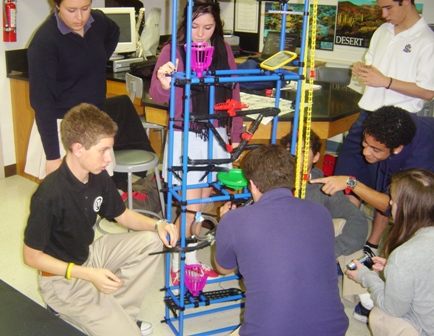
The Conceptual Physics class worked on chaos towers to demonstrate concepts of Physics, Mechanics, Falling Objects, Newton's Law, Potential and Kinetic Energy.

CHAOS WORLD OF MOTION

Teaching Physics Toy - Construction Toy Equipment - Child Construction Toy - Educational Learning Toy


Students work in three groups to construct the chaos towers. They then draw vector diagrams representing velocity of the marble through the track.  Students then identify five concepts from first semester physics and explain how they are represented on the chaos tower.  Lastly, they evaluate each member of their group against the Three C's: collaboration, communication and critical thinking. 


This year one of my students put together a quick video of the chaos towers in action. 


Monday, October 24, 2011

Why Do Students Hate Word Problems?

If you surveyed your classroom, how many students would say they like word problems?
20%? 10%? 5%? 

I actually did this in my science classes the other day.  Out of eighty-nine students over three class periods, representing sophomores through seniors, I had six students who claimed to like word problems and another three who did the half arm extension of, they kind of like word problems.  Let us give those students the benefit of the doubt and go with all nine students who claim to like word problems. Nine out of eighty-nine is a whopping 10.1%.  This is just about right for classes in a typical high school, when it comes to their desire to do word problems.

Why is there such a disdain for word problems?  Why do many students even balk at attempting word problems?  Why do word problems provoke fear in the hearts of the adolescent scholar?

As a science teacher, it is an absolute necessity that students work through the process of solving word problems.  I do not have the luxury of simply giving worksheets of repetitious, rote equation based problems.
Whether it is stoichiometry and gas law problems in chemistry or projectile motion or density problems in physics, students must be able to read a word problem, extract the necessary values and determine a method for solving for the unknown?

Over the years I have discussed this dilemma of word problems with the students who have made their way through my classroom. After years of gathering this anecdotal evidence, I have come up with three basic reasons that students avoid, dislike, or fear word problems: The Battle of the Left and Right Brain, The Language Barrier and The Lack of a Plan.
  • The Battle of the Left and Right Brain
    • Most students are dominant on one side of the brain.  They are either linear, numeric and organized on the leftt side of the brain or they are, artistic, verbal and feeling on the right side of the brain.  Word problems demand that students use both sides of the brain. Heaven forbid, that students use the left side for numbers and the right side for words simultaneously. They might blow a fuse. 
    • For a word problem determining how far a person traveling on a plane for a certian period of time would travel at a given rate, students dominant on the left want to know the numbers, the formula and how to find an answer.  Students dominant on the right side of the brain want to know where they are going, what are they wearing and what movie is on the plane.
    • Students on the left side of the brain can draw out the numbers but may confuse their significanance because the wording does not make sense.  Students on the right side, can decipher the words but do not necessarily have a purpose for the numbers.  
    • A bridge needs to be created to bring the two sides together.  Left sided individuals need to create charts to transfer the numeric values into an organized meaningful process.  Right sided individuals can use diagrams to transfer the words into a meaningful mathematical purpose
  • The Language Barrier
    • How many word problems have just too much information. Most students get overwhelmed by the sheer wordiness of the word problems.  If their is general discomfort with the math that is only increased by superfluous wording and unfamiliar vocabulary. 
    • For example: Johnny walks his shih tzu around his neighborhood every afternoon.  The evening constitutional usually takes about forty five minutes for the two of them to cover the five block trek through the neighborhood.  If the walk consists of one and a half miles, what is the average speed that they walk?
    • There are forty nine words in this word problem.  The majority of them are not necessary to solve the problem. Many students would have difficulty with several of the words, shih tzu, constitutional and trek. While it is important to increase vocabulary and integrate science and language, students who have difficulty with word problems will simply avoid this type of  word problem due the seemingly imposing amount of words. 
    • Students  must be given the opportunity to develop a sense of success with solving word problems gradually.  With time and greater success, students learn to identify the necessary information and filter out the wording that is unecessary to their problem solving. 
  •  The Lack of a Plan
    • Students need a problem solving plan.  Not a recipe, but an actual problem solving plan that is generic to all types of problems. 
    • I believe the best example of a plan for Problem Solving comes from Rafe Esquith in his book, Teach Like Your Hair is On Fire:
 I have always appreciated the simplicity of this approach, wheter it is for Esquith's grammar school students or AP Calculus students the plan holds true.  I also love the "Put Down Your Pencil" reminder for the brainstorming portion.  Too many students never get started because they don't know where they are going.  This plan forces students to truly develop a means for determining where to start, where to end and the path to choose.  

By providing the proper approach, diffusing their fear and providing a concise plan to solve word problems, most teachers can give students the opportunity to develop success in solving word problems.  They may not ever like them, but they most definitely won't avoid them.


Wednesday, October 19, 2011

Formula Cards

I create formula cards for each of my students to assist them in maniuplating formulas to isolate various variables and help them to solve for each part of a given equation.


Tuesday, August 30, 2011

Viscosity Tube Lab

Speed of the Bubble
Viscosity Tube Set

 
For several years now I have used the Speed of the Bubble Viscosity Tube sets from Educational Innovations as an introduction to speed and velocity.


The viscosity tubes set contains three tubes filled with oils of varying viscosities in three distinct colors.  Students time the movement of a bubble through the oil.  Beginning with the basics of distance over time as the speed of an object, students can calculate the speed each bubble.  Students then create a chart of distances at 2 second time intervals.  From this data students then plot points on distance versus time graph on a coordinate grid.

 
Students continue the process by drawing the line of best fit for the data of each tube and then complete their data by calculating the slope of the line for the data of each tube.  Utilizing this data and the calculations students compare the slope of the line and calculated velocities to gain an understanding of reading a motion graph.

 
From this activity students can demonstrate an understanding of:

  • Distance
  • Defining Viscosity
  • Calculating Speed
  • Calculating Velocity
  • Measuring Techniques
  • Timing Techniques
  • Gathering Data
  • Creating a Data Table
  • Graphing x and y Coordinates
  • Drawing a Line of Best Fit
  • Calculating Slope of a Line
  • Reading a Motion Graph


This Speed of a Bubble Lab is a great way to review basic algebra concepts while introducing the properties of velocity in physics.

Tuesday, June 14, 2011

Buoyancy Tutorial


McGraw Hill provides a wonderful tutorial for teaching concepts of buoyancy.  This tutorial provides opportunities for students to experiment with the buoyancy of a cargo craft.  The craft can be adjusted to varying widths in order to demonstrate the effects of surface area on the displacement of the fluid. 

 
The craft can be set afloat in water, alcohol or mercury so that students can understand the effects of visocity and fluid density on the buoyancy of the object.  Students can add cargo in varying incremental units and witness the displacement of the fluid.  A graduated overflow allows students to measure the volume of fluid displaced and data tables provide a comparision of volumes, mass and density of the fluid and objects.


There is also an option in the tutorial to add force vectors of the fluid, craft and cargo increments to assist students in incorporating free body diagrams to compare buoyant and gravitational forces.

Tuesday, May 03, 2011

CHAOS is an Opportunity to LEARN

"Chaos in the world brings uneasiness, but it also allows the opportunity for creativity and growth."
 - Tom Barrett -

Do you remember Lincoln Logs, Tinker Toys, Erector Sets, Blocks and the Original Legos?
How much did we learn about the basic components of logic, building and physics from the trial and error of playing with these toys both correctly and in some cases incorrectly.  I know I learned about catapults by launching the single notch lincoln logs using the green roof plank as a lever.  I learned about control over the center of gravity by building towers of blocks and unbalanced lego creations. I learned gear and wheel ratios from tinker toys and erector sets.  While I didn't realize I was learning physics, I came to understand physical phenomena through tinkering and experimentation.

In my Physics class I use Chaos Towers ( http://www.chaostoy.com/ ) to allow students to experience the hands on nature of discovering the physics of Newton's Laws, Poential (gravitational) and Kinetic Energy and the basic ideas behind vetors as a means of mapping motion, displacement, velocity and acceleration. 


  I have three chaos towers in my classroom.  I divide students into three teams and give them two class periods to build the towers.  The towers can be built horizontally and vertically.  I make sure at least one of the towers is built horizontally.  The students prefer the vertical version.

The lessons students learn, even before the concepts of physics are the importance of reading and following directions and the job of delegating the work.  I have students grade each other on their contribution to the building of the tower and collaboration and communication within the group. 
 
Once the towers are built, students analyze directional changes and displacement values of the path of the marbles.  Students determine the gravitational potential energy at various points along the path and compare velocities based upon the PE = KE formula and measured velocities. The trampoline offers students the understanding of action and reaction forces as well as the parabolic arc of a projectile. 

On the Chaos Toy website there a several lessons utilizing smaller component portions of the towers. http://www.chaostoy.com/cd/html/defau_e.htm

The hands on nature of the tower and the collaborative aspects of the group work, provide a tremendous learning environment for my students.


"I have great belief in the fact that whenever there is chaos, it creates wonderful thinking. I consider chaos a gift."
   

Wednesday, April 13, 2011

Aluminum Boats, Pennies and Archimedes

  
A 10cm x 10cm piece of aluminum foil, 30cm x 1.9cm length of scotch tape and a handful of pennies, now figure out what makes a battleship float.


For five years now, I have utilized aluminum boat building as a means of having students discover he principles of buoyancy.  Students work collaboratively to create an aluminum foil boat that will float while supporting the greatest number of pennies without sinking.  Each students is given three 10cm x 10cm pieces of aluminum foil and three 30cm pieces of tape to design three boats.  Each boat will be placed in a tub of water.  Students will test the buoyancy of their design by adding pennies to the boat until the boat sinks.


Students collaborate to evaluate and critique each boat for the effectiveness as a penny cargo ship.  Typically students will work in lab groups of four or five members and will evaluate the buoyancy principles of as many as 15 different designs.  Students collect data on the mass of the boats, mass of the pennies, surface area of the boat and water displacement.  Utilizing this information they can work through what makes an object float and associate these concepts using Archimedes Principles.

Students experience research and design concepts in a very simple lab while applying the physics concepts for buoyancy that allow an air craft carrier or cruise ship to float.