Showing posts with label Problem Solving. Show all posts

Tuesday, August 28, 2012

What will be on the Final Exam?

Invariably at the end of a semester, despite the organized meandering of the teacher, a group of students will ask, "What will be on the Final Exam?"  Not that they hane not sat through every class and taken copious amount of notes, and completed all of the homework including all of the in class work and the study guides that the teacher has provided. But,without fail, the question will be asked.
What will be on the Final Exam?

 
By the way, I have discovered XtraNormal.com and I am having way too much fun with it.
Not only making my own videos, but looking for ways to incorporate it into my classroom curriculum and have the students creating these video pieces, to share information, create reviews for the "Final Exam" etc...

I will keep you posted when I decide how this will happen in my classroom.

Tuesday, April 17, 2012

Problem Solving with SCAMPER

One of the greatest difficulties students face is thinking outside of the box on their own.

Education has so handcuffed students into thinking the way the teacher wants, the book explains, the rubric directs or the directions instruct, that they have become incapable of striking out on their own for fear of being, OH MY GOSH!!! WRONG!!!!


Bob Eberle developed the SCAMPER system in 1982 to assist students in ways to creatively approach problem solving.

SCAMPER is an acronym of options students can call upon in their approach to solving problems by creative means when thinking outside the box and extending the boundaries is a necessary part of the process solution.
S - SUBSTITUE       What other material, process, method could we use instead?
C - COMBINE         What can we add, cluster or put together to change our perspective?
A - ADAPT               What can we change, adjust or do differently to fit the situation?
M - MODIFY           How can we alter or change the form or quality? Can we resize the form?
P - PUT TO USE      What else could this be used for? Where can this be valuable?
E - ELIMINATE      What could we remove or omit to change our perspective?
R - REVERSE          Could we deconstruct the information to understand the process?    

How many of us have witnessed that classroom where every students can follow directions and achieve the desired result? The classroom where 32 paper look exactly the same because each student can follow the designed algorithm and produce the expected end product?

But, can these same students think out side the box, without a rubric, without specified directions, without a known value as an outcome?  Can these students bring something to the table from another classroom, from a life experience or from another source and derive their own outcome?

It is imperative that the process of learning provide students the opportunity to problem solve free from expectation of producing an expected outcome.  To be able to experience the processes of due diligence necessary to produce an outcome, correct or otherwise.  A process that allows students to make mistakes without judgement, but encouragement to search out a better solution.  A learning environment that values that process as a means to an outcome but not the only outcome.

Allow students to SCAMPER.   


Monday, October 24, 2011

Why Do Students Hate Word Problems?

If you surveyed your classroom, how many students would say they like word problems?
20%? 10%? 5%? 

I actually did this in my science classes the other day.  Out of eighty-nine students over three class periods, representing sophomores through seniors, I had six students who claimed to like word problems and another three who did the half arm extension of, they kind of like word problems.  Let us give those students the benefit of the doubt and go with all nine students who claim to like word problems. Nine out of eighty-nine is a whopping 10.1%.  This is just about right for classes in a typical high school, when it comes to their desire to do word problems.

Why is there such a disdain for word problems?  Why do many students even balk at attempting word problems?  Why do word problems provoke fear in the hearts of the adolescent scholar?

As a science teacher, it is an absolute necessity that students work through the process of solving word problems.  I do not have the luxury of simply giving worksheets of repetitious, rote equation based problems.
Whether it is stoichiometry and gas law problems in chemistry or projectile motion or density problems in physics, students must be able to read a word problem, extract the necessary values and determine a method for solving for the unknown?

Over the years I have discussed this dilemma of word problems with the students who have made their way through my classroom. After years of gathering this anecdotal evidence, I have come up with three basic reasons that students avoid, dislike, or fear word problems: The Battle of the Left and Right Brain, The Language Barrier and The Lack of a Plan.
  • The Battle of the Left and Right Brain
    • Most students are dominant on one side of the brain.  They are either linear, numeric and organized on the leftt side of the brain or they are, artistic, verbal and feeling on the right side of the brain.  Word problems demand that students use both sides of the brain. Heaven forbid, that students use the left side for numbers and the right side for words simultaneously. They might blow a fuse. 
    • For a word problem determining how far a person traveling on a plane for a certian period of time would travel at a given rate, students dominant on the left want to know the numbers, the formula and how to find an answer.  Students dominant on the right side of the brain want to know where they are going, what are they wearing and what movie is on the plane.
    • Students on the left side of the brain can draw out the numbers but may confuse their significanance because the wording does not make sense.  Students on the right side, can decipher the words but do not necessarily have a purpose for the numbers.  
    • A bridge needs to be created to bring the two sides together.  Left sided individuals need to create charts to transfer the numeric values into an organized meaningful process.  Right sided individuals can use diagrams to transfer the words into a meaningful mathematical purpose
  • The Language Barrier
    • How many word problems have just too much information. Most students get overwhelmed by the sheer wordiness of the word problems.  If their is general discomfort with the math that is only increased by superfluous wording and unfamiliar vocabulary. 
    • For example: Johnny walks his shih tzu around his neighborhood every afternoon.  The evening constitutional usually takes about forty five minutes for the two of them to cover the five block trek through the neighborhood.  If the walk consists of one and a half miles, what is the average speed that they walk?
    • There are forty nine words in this word problem.  The majority of them are not necessary to solve the problem. Many students would have difficulty with several of the words, shih tzu, constitutional and trek. While it is important to increase vocabulary and integrate science and language, students who have difficulty with word problems will simply avoid this type of  word problem due the seemingly imposing amount of words. 
    • Students  must be given the opportunity to develop a sense of success with solving word problems gradually.  With time and greater success, students learn to identify the necessary information and filter out the wording that is unecessary to their problem solving. 
  •  The Lack of a Plan
    • Students need a problem solving plan.  Not a recipe, but an actual problem solving plan that is generic to all types of problems. 
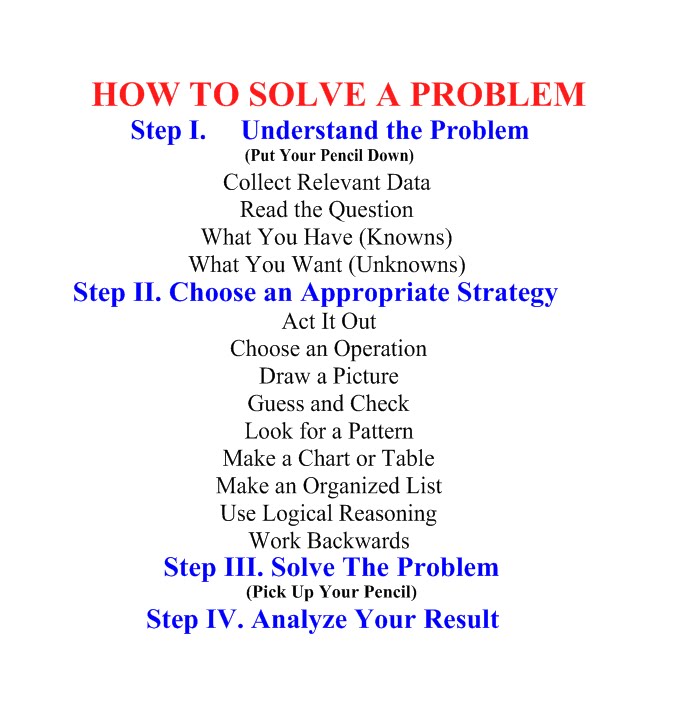
    • I believe the best example of a plan for Problem Solving comes from Rafe Esquith in his book, Teach Like Your Hair is On Fire:
 I have always appreciated the simplicity of this approach, wheter it is for Esquith's grammar school students or AP Calculus students the plan holds true.  I also love the "Put Down Your Pencil" reminder for the brainstorming portion.  Too many students never get started because they don't know where they are going.  This plan forces students to truly develop a means for determining where to start, where to end and the path to choose.  

By providing the proper approach, diffusing their fear and providing a concise plan to solve word problems, most teachers can give students the opportunity to develop success in solving word problems.  They may not ever like them, but they most definitely won't avoid them.


Wednesday, October 05, 2011

Procrastinate! Who me? I'll do it tomorrow.

Getting started is half -done.
And yet, half the battle is sometimes simple recognition of the problem.
Most of us at one time or another have come across an activity, task, assignment or challenge that we are just not ready, willing or able to attack.
In those cases we find every possible means possible to delay the inevitable. 
PROCRASTINATION
What kind of procrastinator are you? 


• Focus on what’s realistic rather than what’s ideal; work toward excellence rather than perfection.
• Seek support from others before you’re under too much pressure.
• Deliberately make one mistake each day.
• Make daily to-do lists with small, broken-down tasks that you can complete on a given day.
• Commit to rewarding yourself for setting and achieving realistic goals.
• Admit that you choose what you do with your time; work on self-acceptance skills


• Learn to make realistic judgments about the time and effort required to complete a task. Ask a friend for help, if needed.
• Remind yourself that choosing not to make a decision about a task or action is itself a decision.
• Don’t allow "what if" thinking to take you out of action.
• Break down tasks into manageable parts to reduce anxiety.
• Every day, do at least part of one thing you’ve been putting off because you’re uncomfortable about it.
• Consider the aspects of a project that are exciting to you, rather than just the challenges.


• Strive for moderation: avoid speaking and thinking in dramatic, emotional language.
• Remind yourself: you may not be interested in a task until you start.
• Identify motivators for a task and use them rather than using stress as a motivator.
• Keep a record of your "crises": what triggered them, how you reacted.
• Create deadlines for yourself as a way to use your natural adrenaline rush to complete tasks earlier.
• Regularly engage in activities that will give you an adrenaline rush-- play competitive sports, go out with friends, or take up a new hobby.


• Recognize and respect your personal limitations. 
• Rank your priorities in life and post this list somewhere. Make choices about your time in accordance with this list.
• Incorporate time to relax into your schedule—and learn to enjoy it. Don’t feel guilty about taking time for yourself.
• Focus your thoughts on how to gain personal control, rather than how tasks control you.
• Learn to say "no" to tasks when appropriate. Try saying a pleasant "no" each day.
• Envision life as an adventure in making choices, not a struggle to do everything.
• Make daily to-do lists based on true priorities

• Rank your priorities in life, and devote your energies accordingly. Post this list somewhere.
• Reflect on the ways you could potentially respond to a task before acting.• Be aware when you’re choosing defiance. Ask yourself whether long-term regrets are worth short-term pleasure.
• Strive to act, rather than react.
• Learn self-calming strategies.
• Own up to your actions—especially if you did not complete a task you agreed to.
• Choose one task every week that you will complete in your own way in order to satisfy your need for individuality.


• Try to differentiate between dreams that are vague and goals that are specific and measurable.
• Make your dream into a goal: define what, when, where, who, why, and how you will complete it.
• Keep a to-do list and assign yourself a few tasks each day.
• Use an alarm or timer as a way to remind you when to get to work.
• Schedule time for creative daydreaming.
• Plan out projects and tasks in writing.
• To counteract mind-wandering, get active—explain things aloud, teach the material to someone, or tackle a small part of your project.

 This information was given to me during a presentation on building student study skills
at an AP Workshop a few years ago. 

Friday, January 14, 2011

Problem Solving Plan


Do our students truly understand that Problem Solving is a process they need to master. I really like this Problem Solving plan. I especially appreciate the (Put the Pencil Down)and (Pick the Pencil Up) notations. I spend a great deal of time making sure my students appreciate the process of problem solving rather than just finding an answer.