Wednesday, June 08, 2011

How Awesome Is This Opportunity?

I finally viewed Waiting for Superman last friday night.

http://www.waitingforsuperman.com/action/

The documentary created by filmmaker Davis Gugenheim explores the ongoing struggle of the American public education system as in most areas it continues to  fail our nation's children. The film explores the roles that charter schools and education reformers could play in offering hope for the future. The statistics which we are bombarded with every day  include the growing student drop out rate, continued deficiencies in science and math education, and schools constantly dealing with a lack of funding. The film brings to life the names and faces of the children whose entire futures are at stake. There was a time when the American public education system was a model admired by the entire world. Today other countries are surpassing us in every respect, and the slogan "No Child Left Behind" has become a cynical punch line. the documentary follows the lives and school choice options of Bianca, Emily, Anthony, Daisy, and Francisco. These five students deserve far better than what is currently offered by today's educational system. The current system is actually obstructing their education instead of bolstering it, Gugenheim instigates the discussion of what is possible and the options for improvement.


I was moved by the plight of the five students they followed throughout the documentary.  Witnessing the lack of options available to these young and promising  minds and to realize that much of their fate is dependent upon the bounce of a bingo ball, the turn of a raffle cylinder or the random sorting program of a computer, had a great impact on me.  As an educator, I became angry at a public school system mired in beuracracy and held captive by government red tape and special interests. But, on the other hand, as a Catholic School Educator I was invigorated by a sense of how tremendous is the opportunity I am given when parents entrust their children to our care.  How absolutely awesome is this responsibility to provide a learning environment that will allow these students to become extraordinary individuals who will make positive impacts on this world we share? 

I can not wait to get back in my class room next fall.

And now the real work begins. 
Summer Preparation


Tuesday, June 07, 2011

Laughter, a Necessity in Any Classroom

Have you ever been in a classroom where the atmosphere is so tension filled that students are afraid to do anything?  Where there are so many rules and regulations that students can not even feel free to think?  Where the environment is so rigid that students feel trapped? Where the idea of enjoying themselves is not even part of the realm of possibilities?

Sometimes as adults we forget that the most basic joy in life is plain and simply joy itself. There is nothing more magical nor joyful than the sound of laughter.  The utter sense of release given up with a burst of pure happiness.  There is a reason that for more than eighty years Reader's Digest has published Laughter is the Best Medicine.

Peter Doskoch wrote about the power of humor in Psycholology Today.  Here are some of the key points of his work:

Laughter
  • Loosens up the mental gears and helps us to think more creatively.
  • Helps us cope with the difficulties of life.
  • Reduces our levels of stress.
  • Relaxes us as it lowers our heart rate and blood pressure.
  • Connects us with others and helps to eliminate feelings of alienation and inadequacy.
  • Releases endorphins, the brain's natural painkillers. 

Thursday, June 02, 2011

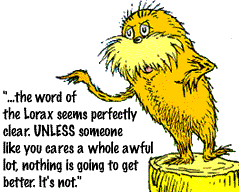
The Lorax Message Still Familiar 40 Years Later

It is not uncommon to find Dr. Seuss books in a kindergarten and elementary classroom.  These books have been a staple of reading for more than fifty years.  Whether students learned colors and numbers from One Fish, Two Fish, Red Fish, Blue Fish or the alphabet with the Dr. Seuss Dictionary, Theodore Giesel has been a soldier for literacy in education world wide.  How often though do we revisit this master of education throughout the years.  Do we explore the possibilities of following our dreams in Oh, The Places You Will Go?   Do we use The Sneetches, to discuss social justice issues?  I have used The Lorax in my environmental science courses for more than a half dozen years.  It is amazing how many ideas and discussion points on the environment are encapsulated in this story. And, high school students truly enjoy using this piece of their childhood to begin the exploration of this course.


In 1971 Dr. Seuss (Theodore Giesel) published "The Lorax" one year after the first Earth Day.
The Lorax speaks out for the Truffula Trees that are being exploited by The Onceler in the production of Thneeds.  Thneeds of course become the latest greatest of the can do everything product that of course everyone needs.   The Onceler's overproduction of Thneeds, leads to overpopulation, urbanization, urban blight, water and air pollution, endangering species and many of the same environmental issues we are still dealing with today.

I utilize the  Google Video of the Lorax as an introduction to the frustration we still deal with in trying to overcome environmental issues.  I ask students to identify the environmental issues presented in the Lorax story and compare them to how those issues are still manifested today.  A major discussion point centers around why these problems never seem to gt solved.  What are the roadblocks that we face in reversing the problems of the environment.  After viewing the video students are asked to write an essay responding to the prompt, "Why we have not learned in forty years."


In summation the basic idea is to get students to answer the following throughout the semester and the remainder of their lives. How are they going to respond to the UNLESS!!!


Wednesday, June 01, 2011

Four Reasons Students Forget Information

You can teach a student a lesson for a day; but if you can teach him to learn by creating curiosity, he will continue the learning process as long as he lives. 
                                               ~Clay P. Bedford

 
They Did Not Use The Information
"I told them this, fifty times this year!"
Unfortunately, sheer repetition of a verbal-auditory stimulus does not allow the majority of students to transfer knowledge into long term memory.  In order to synthesize information completely, students must be able to associate the information to some purpose.  Purpose typically means a specific use.  Students must determine that the information has some meaningful purpose.  When the student can apply it to something useful to some real life situation, they are more apt to retain the information and transition it into long term memory. 

They Confuse It With Other Information 
Let's face it there is way too much information out there.  The glut of information that students deal with everyday is overwhelming.  There are bits of information that I have garnered over my fifty years that I will never forget and never confuse.  There are also concepts and ideas that no matter how many years I teach them I still need to look them up and review them each year before I share them wiht my students.  If, I confuse things after twenty-five years of teaching, I think that high school students after nine months of a subject could very easily confuse material.  Teaching students to distinguish differences, to understand patterns and sometimes using logic and common sense can help them avoid confusion. In the long run we all get confused once in a while.

They Decide That Information Conflicts With Their Previous Knowledge
We all do this.  We get comfortable with an idea and that is that.  Sometimes, this is the most difficult part of being a teachier or coach.  Overcoming, ideas, skills and patterns that have been taught either incorrectly or in a matter that will not allow students to progress. Let's face it.  Habits are hard to break, and bad habits are the worst.  Unfortunately for most of us, our students are not clean slates when they arrive and we must find ways to allow the students entrusted to our care to see value in all knowledge and to learn to evaluate information and see it's purpose. 

Never Really Learned The Information In The First Place 
Just because a student completed the assignment, or passed a quiz does not necessarily mean that they learned the material. In today's, fill me up, take a test, empty me out, method of learning, what are the markers that we can use to truly measure what a student has learned?  Versus, what a student simply has processed in order to complete the assignment, quiz or test for the purpose of the grade?  How often do we ask our students to demonstrate what they have learned in a way that is meaningful for them as learners and for us as educators? 


I hear and I forget.


I see and I remember.


I do and I understand.


                                           ~ Confucius ~